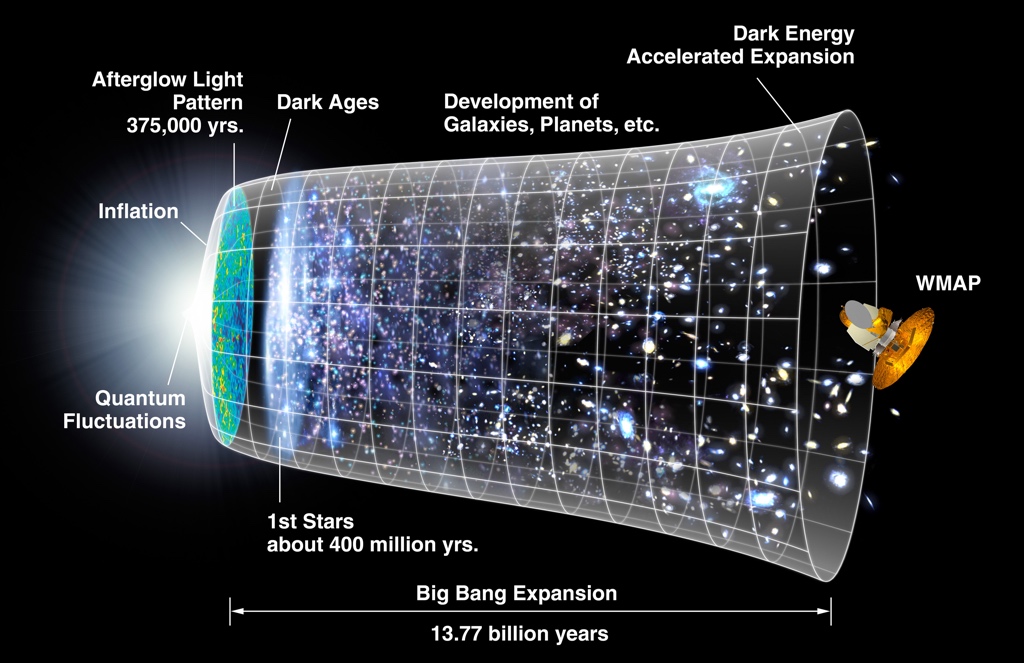
A Timeline of the Universe
This diagram shows a short timeline of the universe. At very early times (< 10-32 seconds), it is thought that the universe had this very rapid inflationary phase, where quantum fluctuations were blown up to macroscopic scales. After this brief period of exponential growth, the universe then transitioned into a more gradual phase of expansion and cooling. At a time of 400,000 years after the Big Bang, protons first recombined with the available electrons in an event known as recombination, leaving photons to wander the universe freely. The universe then entered a dark age for a period of several hundred million years, until the first stars and galaxies formed. Subsequent to this time, galaxies have been merging and coalescing to become larger and more mature systems.
The Beginning of the Universe
It is now widely agreed that the universe started in a hot big bang. The quantum fluctuations which were present shortly after the Planck time were blown up onto macroscopic scales by a short period of highly rapid growth during the first 10-32 seconds of the universe. The early period of rapid growth is called inflation and is thought responsible for the remarkable degree of homogeneity seen in the early universe as well as the small amounts of structure present then.
Then, what followed this early inflationary phase of the universe was a more gradual, normal evolution, where the universe continued to cool and expand. During this cooling phase, the first protons and neutrons condensed out of the mix, and then hydrogen, helium, lithium, and beryllium froze out. Eventually, when the universe was 400,000 years old, the universe had cooled to the point where the ambient photons in the universe were no longer energetic enough to keep hydrogen ionized. This resulted in one of the first truly great phase changes in the state of elemental hydrogen during our universe's history. Hydrogen — which up to this point existed in the fully ionized form as free protons — recombined with the available electrons to form neutron hydrogen. At the same time, the ambient radiation — now too low energy to ionize hydrogen — were simply left free to wander the universe. This background radiation is still with us today in a much cooler form and provides us with one of the first and powerful pieces of evidence for existence of the hot Big Bang. The significance of this epoch is such that it has earned the special name "recombination" to highlight this significance.
The Dark Ages/First Light
As time went on, more matter and stars were pulled onto these overdensities, resulting in the formation of the first galaxies. These galaxies then merged with other galaxies to form larger galaxies — and the whole process of galaxy buildup had begun.
The formation of the first stars and first galaxies brought about several fundamental changes in the rapidly evolving universe. For one, these stars provided the universe with its first source of elements heavier than beryllium. While conditions early on in the big bang were not appropriate for the generation of the heavier elements, such elements could easily be generated at the cores of massive stars and then later expelled into the surrounding universe when these stars explode as supernovae. The second profound change brought about this first generation of stars was the introduction of high-energy photons into the universe. Previously, the last the universe had seen of such high-energy photons was during the first 400,000 years of the universe when the universe was still very hot and hydrogen still existed in an ionized state.
These high-energy photons started what was likely a rather extended process by which hydrogen in the universe was reionized. This reionization process apparently began several hundred million years after the Big Bang and finished some 600 million years later. Currently, there is great interest in understanding the properties of the first galaxies because they likely played a key role in this process.
The first generation of small galaxies was likely well in place 400 million years after the Big Bang. Following this initial phase of galaxy formation, galaxies then went through an extended phase of merging and coalescence with other galaxies, whereby they built up from masses of several thousand solar masses to billions of solar masses. This buildup process extended until the universe was roughly two billion years old. Then, due to some feedback process -- now predominantly speculated to be AGN feedback -- it is thought that this buildup process halted and gas accretion and star formation in the most massive galaxies halted and galaxies underwent a much different form of evolution. This later evolution continues to the present day.
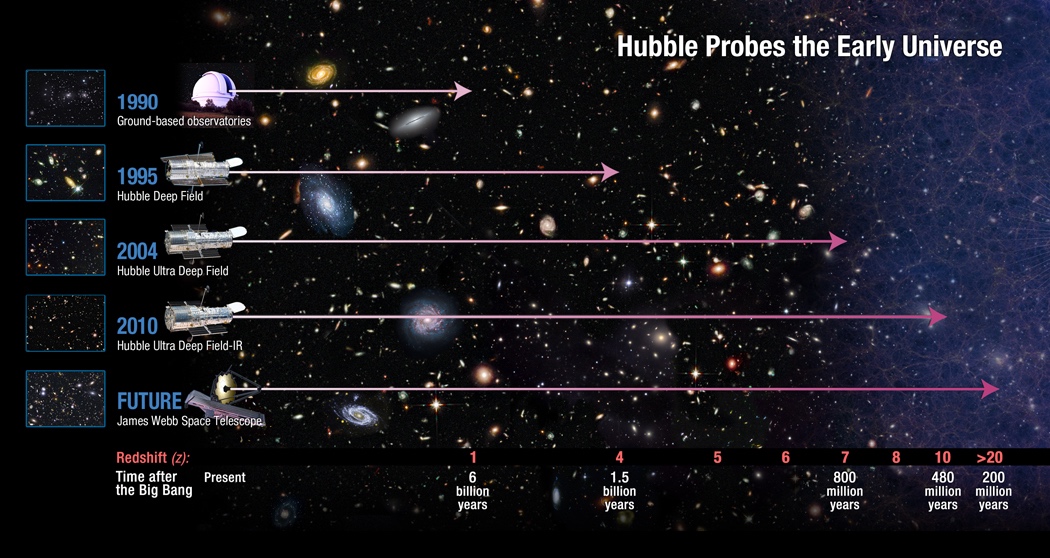
Hubble Looking Back in Time
This timeline of the universe demonstrates how far back the current generation of deep images bring us. For example, galaxies seen in the Hubble Ultra Deep Field (the deepest image ever taken by human kind) date to as early as 700-900 million years after the Big Bang (5-7% of the age of the universe). Since the first galaxies and stars are thought to form just 200-300 million years after the Big Bang, current observations are now bringing us very close to first light.
Searching for the First Galaxies
To locate galaxies which were forming near the beginning of the universe, astronomers look for sources which have very high redshifts.
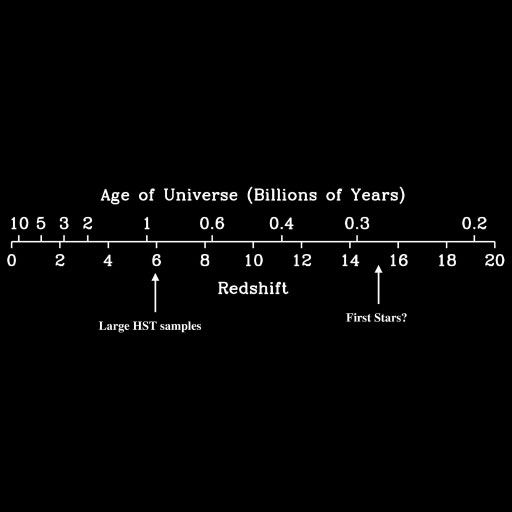
Age/Redshift of the Universe
This figure shows a timeline of the universe, which relates the age of the universe to the redshift. Redshift is a quantity astronomers use to measure how much the light from distant galaxies has shifted towards redder wavelengths due to the expansion of the universe. Galaxies which emit light at very early times have very high redshifts. As a result of our detailed knowledge of how the universe expands, we are able to obtain an approximate relationship between the age of the universe and the redshift a galaxy would have if it emitted light at that time.
Cosmic Redshift
As a result of the expansion of the universe, light from distant galaxies shifts towards longer wavelengths. The process is called redshifting and is fairly analogous to the well-known Doppler effect where an increase in pitch is noted for approaching sounds and a decrease is noted for receding sounds.
The redshift of a source tells us how much light from that source has been shifted in wavelength since it was originally emitted. For example, a redshift of 2 means that light from a source has tripled in wavelength since it was emitted, a redshift of 3 means that light from a source has quadrupled in wavelength since it was emitted, and a redshift of 0 means that there was no change in the wavelength of light since emission. Redshift is usually abbreviated as "z." Since the redshift of a source tells astronomers how much smaller the universe was when the source emitted its light, astronomers are able to use the redshift of sources to determine the age of the universe at that time.
At present, current searches for the first galaxies are taking place at redshifts between 6 and 10, which corresponds to between 500 and 900 million years after the Big Bang. Since we know from current WMAP measurements that the universe is 13.6 billion years old, we are looking back to a time, when the universe was just four to seven percent of its current age.
The Drop-Out Method
Astronomers employ a number of different strategies to find sources at the highest redshifts. One of the most popular and useful of these strategies is the "dropout" technique. The "dropout" technique relies upon the fact that the universe is filled with a large amount of neutral hydrogen and this hydrogen absorbs light at wavelengths bluer than 121.6 nm. As a result of this absorption, we see a very distinct break in the spectrum of an object. The position of this break allows us to determine how much the light from a source has been redshifted. For objects with a redshift of 0, there will be no change in the wavelength of this break, and it will occur at 122 nm. However, for objects at redshifts of 6, this break will occur at a much redder wavelength (851 nm).
Astronomers often search for galaxies that emitted their light at specific epochs by searching for this spectral break. They obtain images of the sky at a number of different wavelengths and then look for the sources that disappear or "drop-out" at a specific wavelength. An illustration of what one of the candidate high redshift objects might look like is shown in the figure to the left.
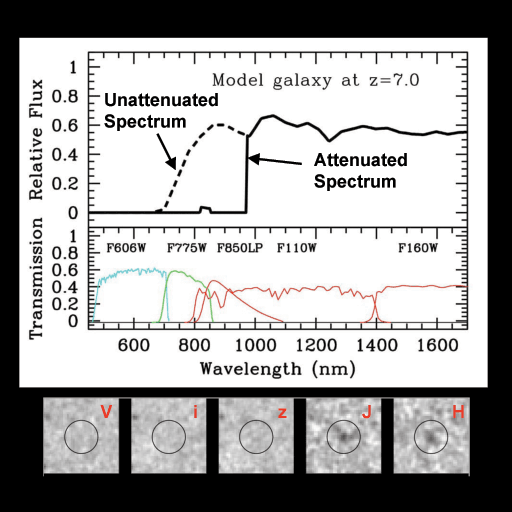
z=7.0 Drop-Out Galaxy
This figure presents one of the most important techniques for finding galaxies at very high redshifts. This technique has been called the "Drop Out" Technique, or Lyman Break Technique. It takes advantage of the significant break that occurs in the spectrum of high-redshift galaxies due to absorption by neutral hydrogen. One possible spectrum of a star-forming galaxy at a redshift of 7 is shown in the top panel. The presence of neutral hydrogen has a rather dramatic effect on the spectrum of this galaxy -- creating a rather abrupt drop off in flux blueward of 970 nm. Astronomers often look for sources which show this abrupt drop off in flux by taking images of the sky using many different filters. Each filter has sensitivity at different wavelengths. The sensitivities of several of the more useful filters on HST are shown in the middle panel and has been used in the acquisition of data for several of the deepest HST images ever obtained (e.g., HUDF). These filters (shown from left to right) have central wavelengths of 591 nm, 776 nm, 944 nm, 1119 nm, and 1604 nm, respectively, and frequently known by the names "V", "i", "z", "J", and "H" bands, respectively. The bottom panel shows images of the redshift 7 source from the top panel, as seen through these filters. This source clearly shows up in the two longest wavelength filters "J" and "H," but completely disappears in the three bluest wavelength filters "V," "i," and "z." The presence of such a distinct break is a clear indication that we have found a galaxy at very high redshift which emitted its light at very early times.
The Drop-Out Method
A short movie showing how the observed spectrum of star-forming galaxies (thick black line) changes as we observe it at higher and higher redshift. Redshift is denoted here in this movie as "z". Note how the break in the spectrum shifts to redder and redder wavelengths as a result of this redshifting effect. To be able to identify galaxies at the highest redshifts (and thus near the beginning of the universe), it is necessary to be able to measure the fluxes of sources at near-infrared wavelengths (>1000 nm). High-redshift galaxies are frequently found by noting a significant break in the spectrum as seen through a set of discrete filters (shown here in terms of their wavelength sensitivities as a set of colored lines). Download the movie: hst_filters_sed_v2.mp4 (with annotations) or hst_filters_sed_v1.mp4 (without annotations)
Some Results
Astronomers employ a number of different strategies to find sources at the highest redshifts. One of the most popular and useful of these strategies is the "dropout" technique. The "dropout" technique relies upon the fact that the universe is filled with a large amount of neutral hydrogen and this hydrogen absorbs light at wavelengths bluer than 121.6 nm. As a result of this absorption, we see a very distinct break in the spectrum of an object. The position of this break allows us to determine how much the light from a source has been redshifted. For objects with a redshift of 0, there will be no change in the wavelength of this break, and it will occur at 122 nm. However, for objects at redshifts of 6, this break will occur at a much redder wavelength (851 nm).
Until recently, considerably less was known about galaxies that existed earlier than 900 million years after the Big Bang. Identifying galaxies at such early times (redshift 7 and greater) was challenging because light from these objects shifts into the infrared. To be able to detect these objects and measure a break, it is necessary to obtain very deep images at both optical and near-infrared wavelengths, and this is not easy to do using ground-based telescopes since there is a significant amount of background light that comes from our own atmosphere. In fact, this background light is some 100,000 times larger than the very faint high-redshift sources we are looking for.
Background light is much less of a problem, if we use telescopes in space to make the observations. To our good fortune, recently a very powerful new instrument known as the Wide Field Camera 3 (WFC3) was installed on the Hubble Space Telescope. WFC3 has a very powerful near-IR camera WFC3/IR that is capable of acquiring exceptionally high quality data. The WFC3/IR instrument is much more efficient at obtaining the data to find distant galaxies than was the previous generation instrument NICMOS -- due to its much wider field of view and greater sensitivity.
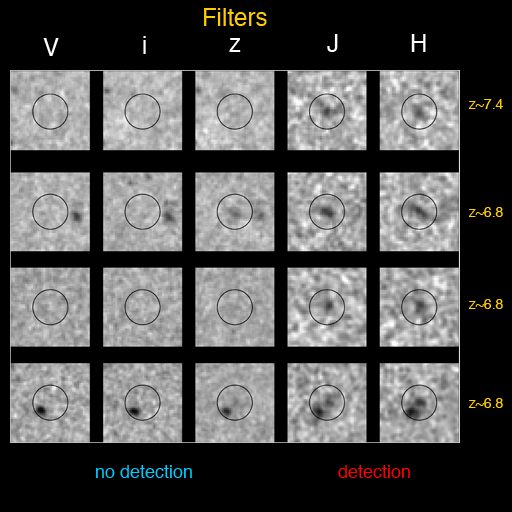
z~7.0 Drop-Out Galaxies
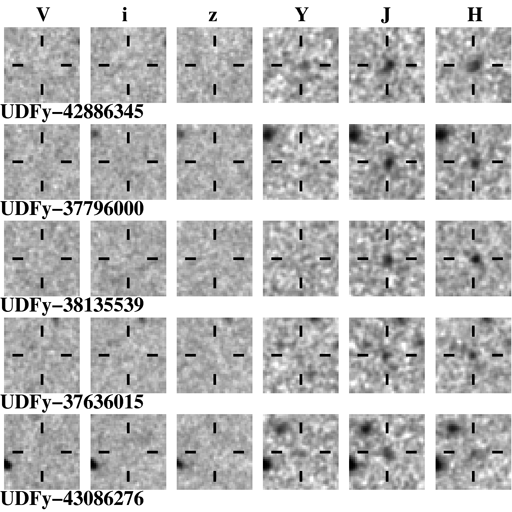
This panel shows four candidate galaxies that are likely to have redshifts of 7 and thus have emitted their light whe n the universe was just 750 million years old. Each of the four candidate high-redshift galaxies are presented in a distinct row. All four candidate galaxies are shown using images at each of five different wavelengths (591 nm, 776 nm, 944 nm, 1119, and 1604 nm). These galaxies are all clearly detected at wavelengths redder than 1000 nm, but remain completely undetected at wavelengths bluer than 800 nm. This abrupt drop-off in the flux is strongly characteristic of star-forming galaxies at high redshifts and occurs due to the absorption of light by the large amounts of neutral hydrogen in the universe at early times. Astronomers use the presence of this break to find high-redshift galaxies. The present sources were found over four years ago in the Hubble Ultra Deep Field and the Great Observatory Origins Deep Survey Fields with NICMOS. The search is described in a paper to Nature we wrote in 2006.
Some results in the search for First Galaxies
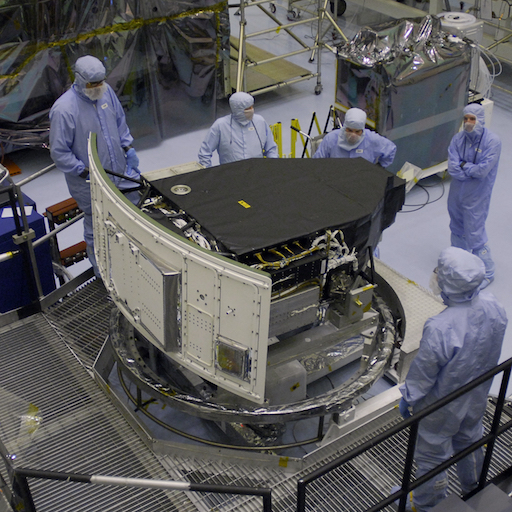
WFC3
The Wide Field Camera 3 (WFC3) is the Hubble Space Telescope's last and most technologically advanced instrument to take images in the near-infrared spectrum. It was installed as a replacement for the Wide Field and Planetary Camera 2 during the first spacewalk of Space Shuttle mission STS-125 on May 14, 2009.
Wide Field Camera 3
Absolutely essential to searching for high-redshift galaxies is the Wide Field Camera 3 (WFC3) which is a new instrument that was installed on the Hubble Space Telescope during HST servicing mission #4. The servicing mission was launched on May 11, 2009 and was a complete success. Though this camera is useful for many areas of astronomy, the near-infrared capabilities of this instrument are particularly exciting for high-redshift science. The near-infrared capabilities of WFC3 significantly exceed the capabilities of the NICMOS instrument on board the Hubble and have increased our capacity for discovery by a factor of 40. Among the improvements are a much larger field of view (a factor of 6 improvement: covering ~4.4 arcmin2 on the sky vs. ~0.8 arcmin2 covered by NICMOS), higher near-infrared sensitivity (improving the quantum efficiency by a factor of 2-3), and a better overall spatial resolution (improving the sharpness of the images by a factor of 3 over NICMOS' wide-area camera). Putting each of these factors together, we effectively gain a factor of roughly 20-40 in the efficiency with which we are able to find sources at high redshifts.
Star Formation History of the Universe
Our research group has been one of the leaders in observational efforts to explore galaxies in the first 2 billion years of the universe. The first 2 billion years of the universe is exciting because it is during this time that we expect galaxies to have built up from a very small number of stars to the large galaxies we see today. It is also during this time period that our universe was reionized and we expect galaxies to have played the key role in this process.
We have a number on-going research projects aimed at finding galaxies over this entire interval of time: from the very earliest times where it is a challenge just to find a small number of sources to later times where the goal is to collect large statistical samples, to study these samples in detail, and to understand how the properties of the galaxy population are changing. Our principal technique for finding galaxies at early times has been the dropout technique, and a detailed explanation can be found here.
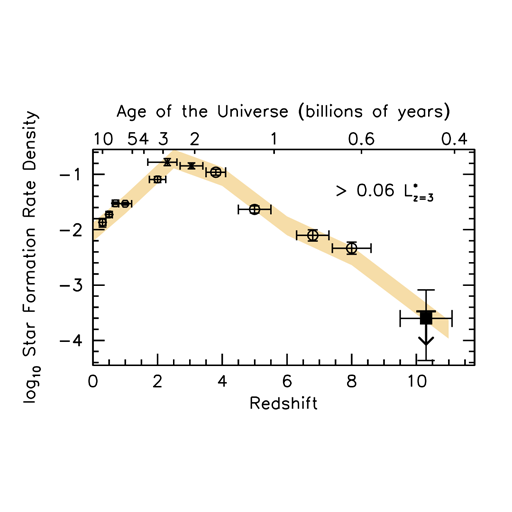
The Star Formation Rate Density
Star Formation Rate Density as a function of the Age of the Universe. The data points show different observational measurements. The star formation rate density increases rapidly from early times to a peak when the universe was about 2 billion years old and then declines. At UC Santa Cruz and Leiden University (Netherlands), we have provided arguably the most robust measurements of this star formation rate density over the first two billion years of the universe (our measurements are shown here in black).
Summary of Our Current Results
Here is a brief summary of our latest research results on early galaxy formation — ordered in terms of the amount of cosmic time from the Big Bang:
~500 million years (Redshift 10)
Since the installation of the WFC3/IR instrument on the Hubble Space Telescope during the fourth servicing mission (SM4), we have been conducting a fairly comprehensive search for galaxies at these early times using the existing WFC3/IR observations. Already a wide variety of deep and ultra-deep WFC3/IR observations are available and now cover well known fields like the Hubble Ultra Deep Field as well as the shallower fields like the GOODS fields and the UKIDSS Ultra Deep Survey field. It is remarkable given the volumes of WFC3/IR data in existence now that we know of so few plausible z~10 candidates. In fact, at present we know of only one source in the HST observations we have examined so far we are suggesting is a plausible z~10 galaxy. Of course, despite the small numbers, it is remarkable that we can use the Hubble Space Telescope to push so far back in cosmic time!
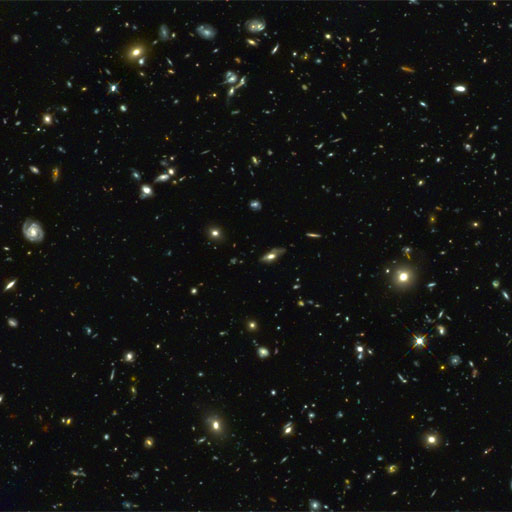
Ultra Deep IR Image
The Hubble Ultra Deep Field WFC3/IR Image. This Region of the Sky Contains the Deepest Optical and Near-Infrared Images Ever Taken of the Universe and is useful for finding star-forming galaxies at redshifts 8 and 10 (650 and 500 million years after the Big Bang, respectively). At UCSC and Leiden, we are using these data to better understand the properties of the first galaxies.
z~7.4 Drop-Out Galaxy
The first five z~8 candidates identified in the first few weeks of science observations with WFC3/IR on the Hubble Ultra Deep Field. All the candidate galaxies appear prominently in the redder wavelength bands, but disappear in the bluest wavelength (< 1 micron) bands.
650 million years (Redshift 8)
We have also been using the new WFC3/IR observations available from the Hubble Space Telescope and large ground-based telescopes to search for galaxies which appear to have emitted their light at redshift z~8. z~8 galaxies are star-forming galaxies whose spectra cut off abruptly at ~1.1 microns due to the neutral hydrogen forest and IGM.
Amazingly, we were able to discover 5 such sources in the first few weeks of science observations with the WFC3/IR camera with HST. We now know of more than >47 z~8 candidate galaxies in the current WFC3/IR observations. This is in significant contrast to 2.5 years ago -- where no good z~8 candidates were known. Interestingly enough, the first z~8 galaxy discovered was from a z=8.2 gamma-ray burst and reported in Nature by two teams: Tanvir et al. and Salvaterra et al.
750 million years (Redshift 7)
z~7 galaxies were first discovered in HST observations over the Hubble Ultra Deep Field with the near-IR NICMOS camera. z~7 galaxies were identified by looking for sources that dropout at wavelengths of ~1000 nm and bluer. However, searches for these sources with NICMOS were not very efficient due to its small field of view and limited sensitivity. As a result, just discovering a small number of candidates required enormous amounts of observing time with HST.In total, only ~10-20 viable z~7 candidates were identified with NICMOS and other ground-based telescopes required like Subaru or the Very Large Telescope.
z~7.4 Drop-Out Galaxy
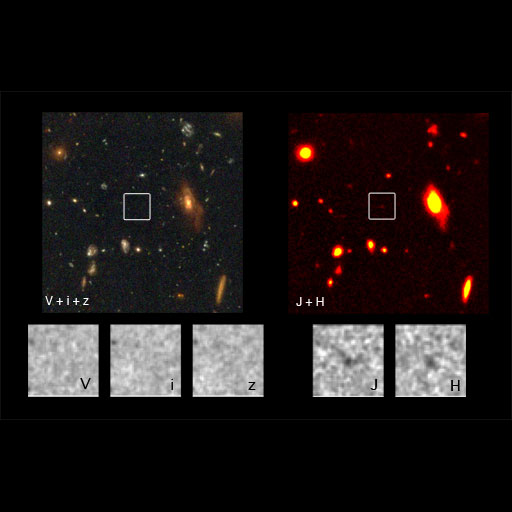
Images of the first robust redshift z>=7 galaxy discovered (inside white box). This galaxy was identified with the NICMOS camera on HST in the Hubble Ultra Deep Field but has been confirmed to be robust with WFC3/IR. This galaxy is seen just 700 million years after the Big Bang. The galaxy disappears at optical wavelengths (left), but is seen clearly in the infrared (right), as shown in the image boxes at the bottom.
Luminosity Functions of Galaxies at Different Cosmic Times
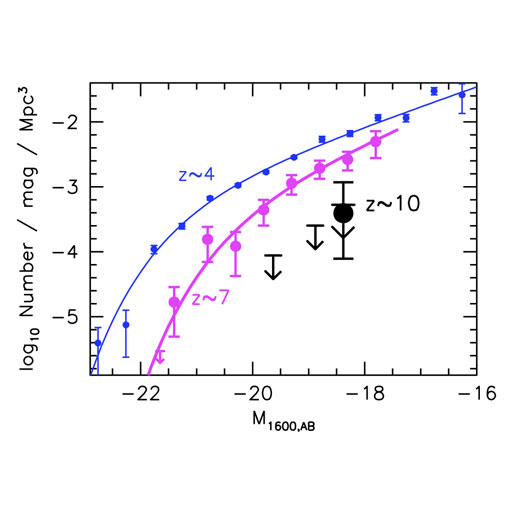
Luminosity Functions of Galaxies at Redshifts of 10 (500 million years after the Big Bang), 7 (750 million years after the Big Bang), and 3 (2000 million years after the Big Bang). The luminosity function tells us the volume density of galaxies (vertical axis) versus their luminosity (horizontal axis). More negative absolute magnitudes (shown on the horizontal axis as "M_1600,AB") correspond to brighter galaxies. The volume densities on the vertical axis are presented in logarithmic units -- so that a more negative number corresponds to a lower abundance. At all epochs galaxies are much more abundant at lower luminosities than they are at higher luminosities. What is interesting here is the evolution observed in the luminosity function from early times (z~10) and much later times (z~3). Galaxies at later times are much brighter and numerous than they are at later times. This is exactly what we expect in hierarchical scenarios where the bright galaxies build up gradually from faint ones. The present diagram includes our luminosity function results through early 2011.
The new WFC3/IR observations are much more useful for finding large numbers of z~7 galaxies. At present we know of almost 100 probable z~7 galaxies.
We have used our searches for z~4-10 galaxies to estimate the volume density of these sources as a function of luminosity -- a quantity known as the luminosity function. The luminosity function is of significant interest to astronomers and allows us to learn something about how the population of galaxies change as a function of cosmic time. Comparisons of the luminosity function of galaxies at z~10 (500 million years after the Big Bang) with those at z~8 (650 million years after the Big Bang), z~7 (780 million years after the Big Bang), and z~4 (1600 million years after the Big Bang) tell us that galaxies at z~7 and z~10 were much less luminous and prevalent than they were at later cosmic times. Since we expect the more luminous galaxies to build up gradually from less luminous galaxies, we might have expected to find such a change at early times. Yet, despite this qualitative agreement with the models, the value in our measurements is that they provide quantitative constraints on how rapidly this build up takes place.
900 million years (Redshift 6)
Over the past few years, we have taken advantage of all the deep optical data over the deepest HST fields to compile a sample of over 600 galaxies at redshift 6. This sample allowed to study the properties of galaxies at these earliest times. Comparisons of this sample with galaxies later on the history of the universe show thatgalaxies at early times were much smaller, bluer, and lower luminosity (on average) than galaxies which existed later on in the universe. Each of these findings is consistent with the idea that galaxies build up hierarchically from much smaller pieces. Our sample is still the largest compilation of galaxies at these early times.
Spectrum of Very Bright Redshift 6 Galaxy
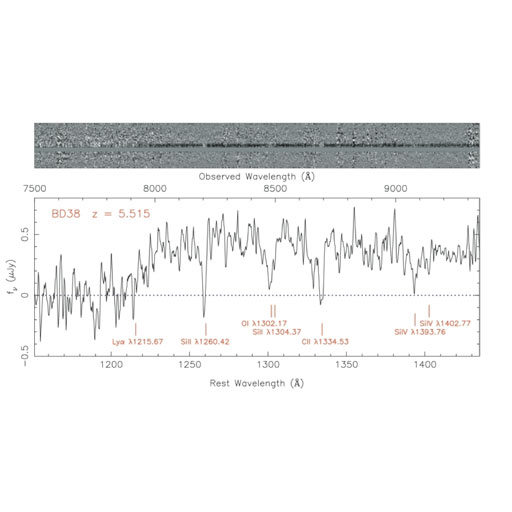
Spectrum of the brightest galaxy known at a redshift 6 (900 million years after the Big Bang). This galaxy also has more stellar mass than any known redshift 6 galaxy. The spectrum is plotted as flux versus rest-frame wavelength (after correcting cosmological redshift). Notice that this spectrum shows no emission at Lyman-alpha (at a wavelength of 1215.67 Angstroms).
Future Observations
Light from the first stars and galaxies is substantially redshifted due to the substantial expansion of the universe since these early times. The redshifts of these sources are significant enough that it is not possible to look at these objects at visible (optical) wavelengths. Instead, one needs to move all the way into the infrared portion of the spectrum.
This is why the newest set of instrumentation for exploring the high-z universe will have exciting new capabilities in the infrared.
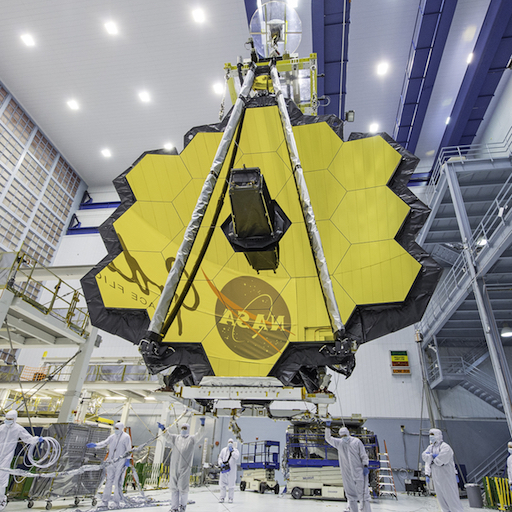
James Webb Space Telescope Mirror Seen in Full Bloom
NASA technicians lift the telescope using a crane and move it inside a clean room at NASA’s Goddard Space Flight Center in Greenbelt, Maryland. Once launched into space, the Webb telescope’s 18-segmented gold mirror is specially designed to capture infrared light from the first galaxies that formed in the early Universe, and will help the telescope peer inside dust clouds where stars and planetary systems are forming today.
James Webb Space Telescope
The James Webb Space Telescope (JWST) represents the next generation of space telescope and should completely revolutionize our ability to image the universe in the infrared. It will have a 6.5 meter primary mirror, which would give it a significant larger collecting area than the mirrors available on the current generation of space telescopes (7.5X larger than HST and 60X larger than the Spitzer Space Telescope). JWST has a planned launch in 2018 and will be in operation for five years. It will positioned a million miles from L2 (the second Lagrange point around the Earth).
JWST will contain four science instruments with imaging and spectroscopic capabilities. These instruments will provide wavelength coverage from 0.7 microns to 29 microns. JWST will have significantly larger field of view than the WFC3/IR camera on HST (covering more than ~4 times the area) and significantly better spatial resolution (~0.13 arcsec) than is available with the Spitzer Space Telescope (~1.5 arcsec). Altogether, its exceptional capabilities mean that we will increase our capacity for discovery science by more than a factor of 1000. With JWST, we should be able to learn more about the high redshift universe (at times less than 700 million years after the Big Bang) in just a few hours of observations than we have been able to learn from all the HST observations taken to date.
Thirty Meter Telescope
The TMT (Thirty Meter Telescope) represents the next generation of large ground-based telescopes and is planned to have a total collecting area which is more than 700 square meters, more than 9 times what is available on the current generation of 10-meter class telescope. Other very large telescopes that are planned include the Giant Magellan Telescope and European Extremely Large Telescope.
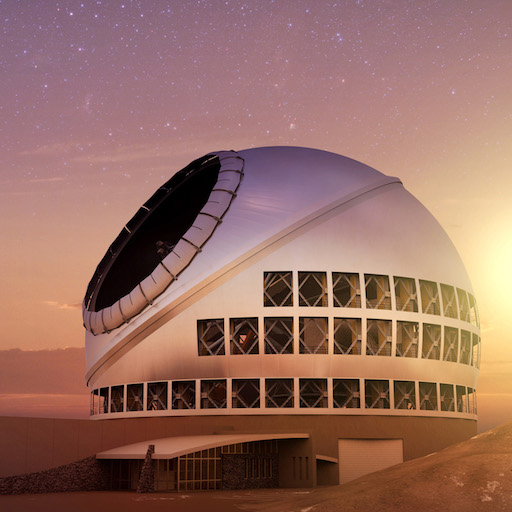
A Photo Illustration of the TMT
The Thirty Meter Telescope (TMT) will be the world’s most advanced and capable ground-based optical, near-infrared, and mid-infrared observatory. It will integrate the latest innovations in precisions control, segmented mirror design, and adaptive optics.